
The One Who Finds Things
familymemory west-texasgriefmarriageI. The evening
The beans had been on the back burner since noon, and the smell of them had filled the house the way it does in winter, when the windows stay shut and the heat has nowhere to carry a smell to but through the rooms. Pinto beans and the ham hock, and under that the cornbread my wife had put in the skillet an hour before, and under that the coffee from the morning warming again on the front eye of the stove. I came in through the mudroom and the cold came in with me, and then the door shut on it.
The central heat did not reach the back of the house. It never had. We kept a kerosene heater in the back room and burned it through the cold months, so the house in January was two houses, a warm one at the front off the wall unit and a cold one at the back, and you knew which one you were standing in by your skin before your eyes had a say in it.
My wife was at the sink. She had the colander under the tap and was rinsing the beans she had set to soak for the next day, and the water ran and she shut it off, and there was the one drag of metal across porcelain as she set the colander on the drainboard. She did not turn around.
In the bedroom the dresser had a runner on it that had been my mother’s, a strip of linen gone the color of weak tea along the folds. The dish sat on the runner. It was my mother’s dish, white with a thin blue band, and there was a chip on the lip of it from the day in 1982 it came off the shelf above her stove, which was before I was old enough to remember it coming off, though I have been told about it more than once. My father kept his change in it for thirty years. I keep one thing in it.
The key was in the dish.
It is a brass key about three inches long, the shaft of it hollow, the kind of key that went to a door lock they have not made in my lifetime, or to a chest, or to a clock that has not been wound in fifty years. My father put it in my hand in the hospital in Lubbock, three weeks before he died, and closed my fingers over it, and did not say what it went to. I did not ask him. There are questions you do not put to a man in that bed, and that was one of them, and by the time I might have been willing to ask it he was past the answering of it. I have carried it in my right front pocket every day since. In the morning I take it out of the dish on my way out of the room, and at night I put it back, and there is a ring worn pale into the linen under the dish where it has has sat for seven years.
The black skillet was on the stove with the cornbread in it. The skillet was older than the dish. It had been my grandmother’s, and her mother’s before that. It had been cooked in so long and washed so careful, never once with soap, that it had a shine on it like a creek stone. Nobody had ever scratched a name in it. The men in my family scratched their names and their dates into whatever they could not carry off, gateposts and fence posts and the slabs of caliche they stood on end in postholes for corner markers, and the women cooked in a thing for sixty years and handed it down warm and did not sign it.
There was a to-do list on the counter, under the salt box. “*Go to Brownfield Thurs” *was one of the items. She drove over to Brownfield every Thursday to sit with my mother at the home, an hour over and an hour back, and she had been driving it two years. I used to drive it with her. I read it and said nothing about it and went and washed my hands at the far end of the sink while she stood at the near end.
She wiped her hands on the tea towel that hung off the oven door. She did not look at me. She had been deciding something for a while, the way you can tell a person has, by how slow they do the small things, slower than the small things need to be done.
The phone rang. It was the wall phone by the kitchen door, the one with the cord, because the cell signal out here comes and goes with the weather and the wall phone does not. She picked it up and said hello and listened a second and held the receiver out to me without a word.
II. The call and the descent
It was my brother.
He was calling about the north fence, and I knew it was the north fence before he said it, because there was nothing else on my father’s place he would call me about at suppertime in January. He came at it the way he came at everything, asking after my wife and after the shop and whether we had gotten any rain, which was a thing we said to each other the way other men say good morning, because nobody had gotten any rain since October.
Then he was quiet a second.
Then he said the north line was down in three places, and that Bud Watkins had been running cattle across it onto our grass for going on two years, and that he had walked the line that morning trying to put his hand on the corner our daddy set in 1973, the piece of caliche he had stood on end in a posthole and scratched the date into the side of with a horseshoe nail, and that he could not find it. He said the mesquite and the catclaw had come up so thick along the line in the years that nobody had run a blade down it that he had walked the whole north side of the section twice and could not lay a hand on the marker. He had been meaning to call me about it since last spring and had let it go, and said we were going to have to do something before Watkins got it in his head that the line ran where his cattle said it ran.
I held the receiver and looked at the back of my wife at the sink. She had not moved. She had her head canted a little to the side, the way she does when she is wondering what’s going on the other side.
Then he said there was one more thing, and his voice changed for it.
He said the home over in Brownfield had called him that afternoon, after they tried to ring the house through the day and could not raise anybody. Our mother had got up the last two nights running and gone down the hall to the front doors looking for my father, who has been seven years in the ground, and that the second night she had got a door open onto the lot before the aide came. He said the home wanted to move her over to the hall where the doors stay locked, and that somebody from the family ought to be there when they did it. He said, “Tell Hannah.” I said I would. We did not settle the fence and we did not settle my mother. He said we would figure something out and I said yeah, and there was the click and the open line, and I stood with the receiver in my hand a second past when I needed to, and it was warm where my hand had been.
I hung it up.
I told my wife the home had called and that they wanted to move my mother to the locked hall. I told her that my mother had been getting up in the night and going to the front doors looking for my father. She set the tea towel down on the counter and stood with her back to me and did not say anything.
I went out the back door without a coat. I stood on the step with the door shut behind me and the yard light buzzing and the cotton stubble going off gray toward the fence line, and I stood there until the cold had got down into me good, and then I went back in. It is a thing I do. When something comes into the house that I cannot sit in the room with, I go out and stand in the yard until I can. I have done it my whole life, and my wife has watched me do it the whole of our marriage, from the window and from the sink, and has never one time come out into the yard after me.
She was not in the kitchen when I came back in. The water was off and the colander was on the drainboard and the back of the house was dark.
I did not decide to go to the bedroom. My feet took me. There is a thing I do when something has come at me from the side and I have not got my hands around it yet, and I did not know I did it until I was past thirty and my wife said something about it once. I go and find the key and I hold it. I do not take it out and turn it over and look at it. I put my hand in my pocket and close it around the key and I hold it as long as the holding takes, and then I can go on. In the evening the key is in the dish and not in my pocket. So I went to the dish.
The dish was on the runner. The key was not.
I picked the dish up and tilted it, as though the key could be hiding behind the curve of a thing the same size as itself. I set it down. I lifted the runner and ran my hand under it across the wood. I opened the top drawer and put my hand under the folded shirts and felt along the bottom to the back, and then the second drawer, and the third, all the way to the back of each one. I got down on the floor and looked under the dresser, where the dust was, and there was no key in the dust. I pulled the bed out from the wall on my side and looked into the dark between the mattress and the box spring and ran my hand the length of the seam. I went to the hamper and took out the pants I had worn the day before and went through the right front pocket, and it was empty, and the left, and the two back pockets, and then I held the pants by the cuffs and shook them, and a dime dropped out and rolled under the bed, and I did not go after it. I turned the hamper over and dumped it on the floor and went through what came out.
I was making a sound. It was coming from the back of my throat, low, on the breath going out, and I did not know I was making it until I stopped to listen for whether my wife was coming down the hall, and the sound stopped when I held my breath, and that was how I knew it had been me.
The year the hail came it took the cotton in about twenty minutes. I would have been nine, or ten. My father stood at the kitchen window and watched it strip the field he had watched all summer, and when it was over he came and sat down at the table and did not say anything. My mother crossed the kitchen and stood in front of him and took his face in both her hands, one to a side, and held it, and she did not say anything either. I sat at the foot of the table and watched my mother hold my father’s face while the hail melted white in the yard. I had not thought about that in years. It came up out of the floor of me while I was down on my knees in the dumped-out hamper hunting for a key that opened nothing.
I checked the coat on the hook by the door. There was nothing in the pockets but a pencil stub and a feed-store receipt gone soft. I stood in the middle of the room I had taken apart.
III. The hinge
My wife came down the hall and stopped in the doorway.
The doorway is where a person stops. She stopped there for the space of one breath and looked at the drawers standing open and the clothes dumped on the floor and me in the middle of it, and she said my name. Once.
She did not ask me what I was looking for. I have come apart in front of my wife over a lost thing before. The truck key, more than once. My glasses. The title to the pickup, one whole Saturday, the two of us going through the house room by room until she turned it up folded inside the owner’s manual in the glovebox where I had put it myself and forgotten. Every time, the first thing she does is ask me what it is I have lost, and the second thing she does is start looking, and the third thing she does is find it, because she is the one who finds things. That is the order it has always gone in.
She did not ask me what it was. She did not start looking. She came across the room and knelt down on the floor in front of me, down in the spilled clothes, the one knee and then the other.
I had sat down on the edge of the bed without knowing I had. The dish was in my left hand. I do not remember picking it up off the runner again, but I had, and it was empty, and I was holding it.
I said, “I just don’t want you to think I’d lose it.”
I did not know what I meant by it until I had said it, and then I had said it, and I could not call it back.
She reached up and took the empty dish out of my left hand and set it on the runner behind her without looking where she set it, and she put her hands up on the two sides of my face. Her hands were cold from the sink water. Her hands have always been small. She held my face the way you hold a thing you are keeping from going off an edge, and she looked at me, and she said, “I know you won’t.”
She held on and after a while the cold went out of her hands into me, or the warm of me went into her hands, one of the two, until you could not have told whose was whose.
Then she let go, and put her hands flat on her knees, and pushed herself up off the floor the way she does it, favoring the one knee, and standing over me she said, low, almost not to me at all, “Mind the road.” It was a thing her grandmother said at the door before she would turn anybody loose to leave the house, and her grandmother had been in the ground nineteen years. My wife said it sometimes without seeming to hear herself say it.
She went back up the hall to the kitchen. I heard the cabinet over the stove open, and the colander go up into it, and the cabinet door come shut.
IV. The morning
I woke before the alarm, the way I do in the winter. The room was cold. The dish was on the runner and the key was in the dish.
I do not know when she put it back, or where she kept it through the dark. I did not ask her where it had been.
She had not asked me, the night before, what I was tearing the room apart to find, and she had not got down and looked for it with me. A person does not skip the asking and the looking both, and come straight across the floor to take hold of your face, unless she already knows the thing is not lost. That was how I knew, lying there in the cold, whose hand it had been in. I did not ask her to say so, and she did not say so.
I got up and dressed in the cold. I went to the dresser and took the key out of the dish and put it down in the right front pocket of my work pants. The pocket took it the way it takes it every morning of my life, closed around it, the cloth there gone soft and a little thin from seven years of the one weight in the one place.
My wife was at the kitchen table with her coffee. She did not look up. She did not need to. I poured half a cup and drank it standing at the counter, and the cornbread was under a dish towel and I did not cut into it. I told her I would go over to Brownfield with her, that I would be there when they moved my mother to the other hall. She said all right and turned her cup a quarter turn on the table and did not look up. On my way past her to the door I laid my hand on the top of her head and she reached up without looking and took the back of my hand a second and let it go.
There was frost on the inside of the windshield. I scraped it off with the edge of a card and started the truck and let it run a minute. I backed out and turned west on the FM road toward town, toward the shop. The cold sat in the cab the first three miles, in my feet and up the shins of me, until the heater took hold and pushed it back down toward the floorboards.
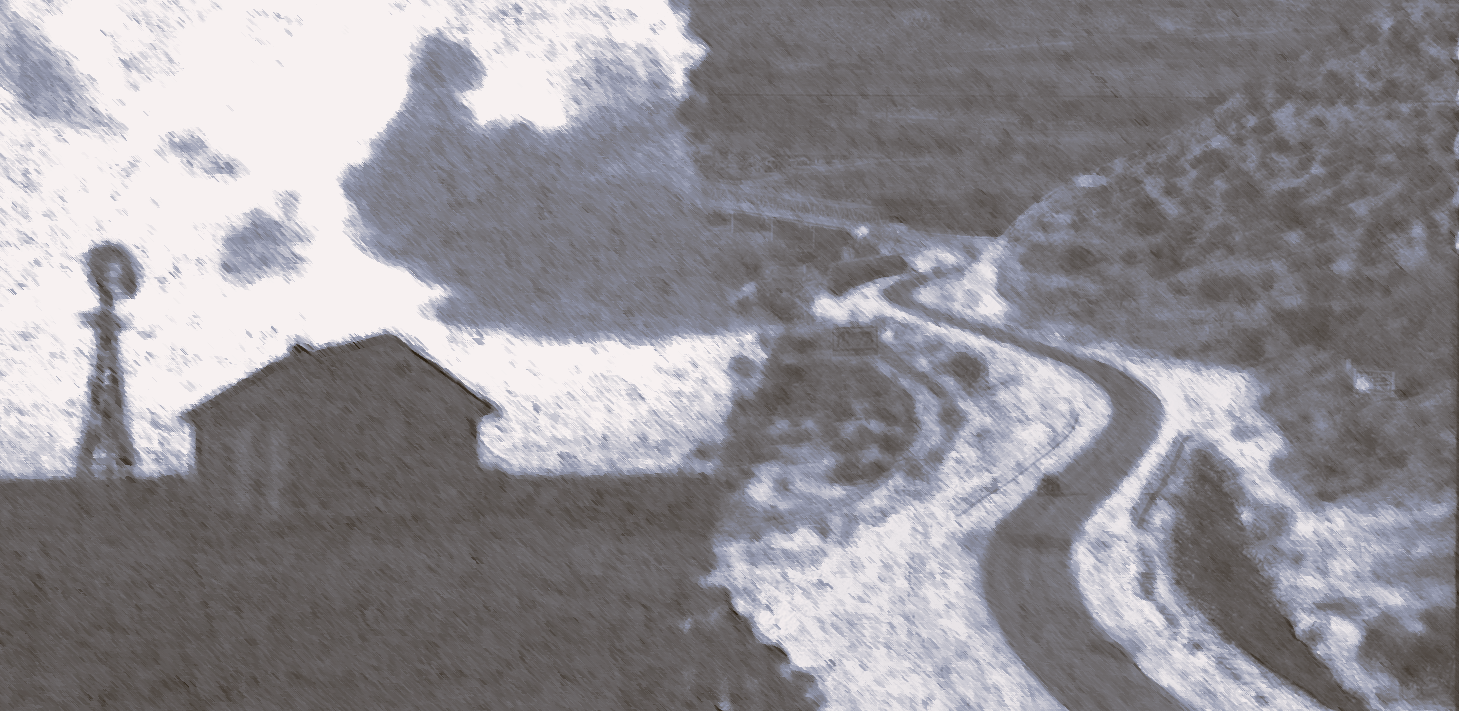
Past the old Pickens section the road bends north along the section line. A mile up from the bend, at the section corner, there is a windmill my father used to carry me out to on Sunday afternoons when I was small, to grease the head of it and to stand under it and listen to it pull water up into the stock tank the cattle came to. I have not driven out to it in years. The turnoff came up on the right, the two ruts running off through the cotton stubble toward the mill, and I kept the truck on the blacktop and went on past it. The windmill stood off there to the north turning in the wind that does not quit out here in winter. Then it was behind me and gone.
I would call my brother at noon, from the shop, where the compressor runs all day and a man stops hearing it. I would tell him I could come out Saturday and we would walk the north line together and look for the marker. I did not know if we would find it.
I put my hand in my pocket and felt the brass, cold and old. I thought about my mother searching for my father. I thought about me searching for the key the night before. Then I thought about my wife, not searching for the key, but searching for me. I thought about the windmill. It turns like I turn the key in my pocket.
I’m ready for the season to turn.